0
Skip to Content
Mada & Hugh Piano Duo
About
Gallery
Music
Tour
Podcast
Patreon
Merch
Blog
Digital Press Kit
Contact
Newsletter
FAQs
Mada & Hugh Piano Duo
About
Gallery
Music
Tour
Podcast
Patreon
Merch
Blog
Digital Press Kit
Contact
Newsletter
FAQs
About
Gallery
Music
Tour
Podcast
Patreon
Merch
Blog
Digital Press Kit
Contact
Newsletter
FAQs
December 9, 2025
Hugh Sung 12/9/25 Hugh Sung 12/9/25

December 9, 2025

Read More
August 25, 2025
Hugh Sung 8/25/25 Hugh Sung 8/25/25

August 25, 2025

Read More
August 5, 2025
Hugh Sung 8/5/25 Hugh Sung 8/5/25

August 5, 2025

Read More
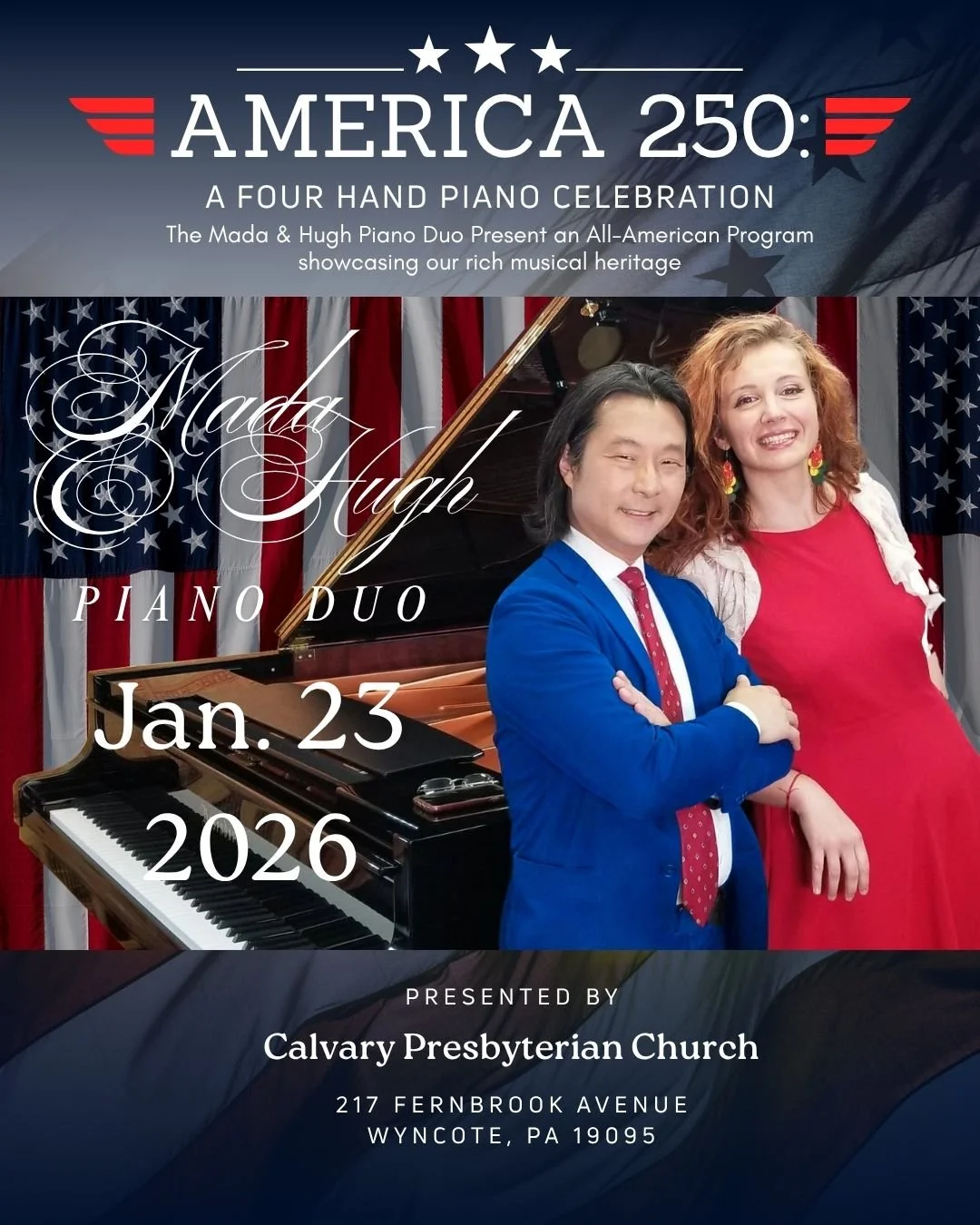
The Concert

An Afternoon of American Music

In honor of America's 250th anniversary, the Mada & Hugh Piano Duo joins Saint Katharine of Siena to offer an afternoon of four-hand piano music that traces the breadth and beauty of the American musical tradition.

From the irresistible rhythms of Gershwin to the wide-open landscapes of Copland, from the theatrical brilliance of Bernstein to the pioneering voice of Florence Price — the program spans nearly a century of music that is unmistakably, gloriously American. Contemporary voices Jennifer Higdon and John Carollo carry that tradition forward, while Samuel Barber's beloved Souvenirs and the sparkling duo pieces of Lawnhurst and Pollack offer moments of pure warmth and delight.

Whether you are a devoted classical music listener or simply someone who loves a beautiful afternoon, this concert is designed to welcome everyone. Come with friends, come with family, and help us celebrate 250 years through the power of music.

Program

What You'll Hear

I
George Gershwin (1898–1937) 3 Preludes arr. Mada & Hugh
II
Aaron Copland (1900–1990) Hoe Down from Rodeo arr. Mada & Hugh
III
Vincent Persichetti (1915–1987) Serenade No. 8, Op. 62 A bene placido  ·  Con grazia  ·  Con calore  ·  Semplice
IV
Florence B. Price (1888–1953) Coreopsis arr. Po-Sim Head & Kowoon Lee
V
Jennifer Higdon (b. 1962) Jumble Dancing
VI
John Carollo (b. 1954) Stranded in Illusions from Phantasmamusica, Book VI
VII
Samuel Barber (1910–1981) Selections from Souvenirs, Op. 28 Waltz  ·  Pas de deux  ·  Two Step  ·  Hesitation-Tango
VIII
Vee Lawnhurst & Muriel Pollack Table d'Hôte Hors d'oeuvres  ·  Soup  ·  Entrée  ·  Salad  ·  Parfait  ·  Demi-Tasse
IX
Leonard Bernstein (1918–1990) "America" from West Side Story arr. Mada & Hugh
Program Notes

About the Composers

A short biography of each composer on this afternoon's program, in the order you'll hear them.

I

George Gershwin (1898–1937)

George Gershwin was an American composer and pianist whose work bridged popular music and classical traditions, making him one of the most influential figures in 20th-century American music. Born Jacob Gershwine in Brooklyn to Russian-Jewish immigrants, he began his career as a song plugger in Tin Pan Alley before achieving fame as a Broadway composer alongside his lyricist brother Ira. His concert works — including Rhapsody in Blue (1924), An American in Paris (1928), and the opera Porgy and Bess (1935) — fused jazz harmonies, blues idioms, and classical forms in ways that defined a distinctly American sound. Gershwin's career was cut short when he died of a brain tumor at age 38, but his catalog of songs ("Summertime," "I Got Rhythm," "Embraceable You") and orchestral pieces remains central to the American repertoire.

II

Aaron Copland (1900–1990)

Often referred to as the "Dean of American Composers," Aaron Copland was one of the most influential and celebrated American composers of the 20th century. Born in Brooklyn to Lithuanian Jewish immigrant parents, he studied in Paris with the renowned pedagogue Nadia Boulanger before returning to the United States to forge a distinctly American sound in classical music. He is best known for his populist works from the 1930s and 1940s, including the ballets Appalachian Spring (which won the Pulitzer Prize for Music in 1945), Billy the Kid, and Rodeo, as well as Fanfare for the Common Man and the Lincoln Portrait, all of which incorporated American folk melodies, jazz elements, and wide-open harmonies that evoked the American landscape and spirit. Beyond composition, Copland was a tireless advocate for American music as a teacher, conductor, writer, and mentor to younger generations of composers.

III

Vincent Persichetti (1915–1987)

Vincent Persichetti was an American composer, teacher, and pianist who became one of the most prolific and influential figures in 20th-century American music. Born in Philadelphia, he demonstrated extraordinary musical precocity, heading the theory department at Combs College of Music at age 20 while simultaneously studying at the Curtis Institute and the Philadelphia Conservatory. He joined the Juilliard School faculty in 1947, where he taught composition for four decades and mentored generations of American composers including Philip Glass, Steve Reich, and Einojuhani Rautavaara. Persichetti composed in virtually every genre — producing nine symphonies, twelve piano sonatas, and numerous concertos — but is perhaps best known for his substantial contributions to wind band literature. His textbook Twentieth-Century Harmony (1961) remains a standard pedagogical resource.

IV

Florence B. Price (1888–1953)

Florence B. Price was a pioneering American composer and the first African-American woman to have a symphony performed by a major American orchestra, when the Chicago Symphony premiered her Symphony No. 1 in E minor in 1933. Born in Little Rock, Arkansas, she graduated from the New England Conservatory of Music and later settled in Chicago, where she composed prolifically across genres — symphonies, concertos, chamber music, art songs, and works for piano and organ — often weaving African-American spirituals and folk idioms into classical forms. Long overlooked after her death, Price's music has experienced a major revival in the 21st century, with recordings, performances, and the rediscovery of lost manuscripts restoring her to her rightful place in the American canon.

V

Jennifer Higdon (b. 1962)

Jennifer Higdon is one of the most celebrated American composers of her generation, known for her vibrant orchestral colors, rhythmic vitality, and emotionally direct musical language. Born in Brooklyn and raised in Georgia and Tennessee, she came to classical music relatively late, teaching herself flute before pursuing composition in college. Her works span orchestral, chamber, choral, vocal, and operatic genres, and are performed by major ensembles around the world. She has received numerous awards including the Pulitzer Prize for Music for her Violin Concerto and multiple Grammy Awards for Best Contemporary Classical Composition. Higdon's music is admired for its immediacy and craftsmanship, making her a prominent voice in modern American concert music.

VI

John Carollo (b. 1954)

John Carollo is an American composer whose emotionally charged works span symphonies, string orchestra pieces, chamber music, song cycles, and solo instrumental compositions. Born in Turin and raised in an Italian orphanage until age four and a half, he was adopted by an Italian-American family and grew up in northwestern Pennsylvania, where he studied piano and sang in his church choir. He earned a master's degree in psychology from San Diego State University and worked as a mental health counselor in Hawaii before retiring in 2006 to compose full-time. His recordings — including Ampersand (winner of Best Classical CD at the Hawaii Music Awards), Transcendence in the Age of War, and Symphony No. 3 — have been released on PARMA/Navona Records, with critics noting his distinctive voice that draws comparisons to Messiaen and Schoenberg while remaining thoroughly original.

VII

Samuel Barber (1910–1981)

Samuel Barber was an American composer known for a lyrical voice that balanced modern clarity with romantic expression. Born in West Chester, Pennsylvania, he showed remarkable musical talent from an early age and entered the Curtis Institute of Music as one of its first students. Barber's music includes orchestral, operatic, choral, and chamber works, yet he is best remembered for Adagio for Strings, a piece that became one of the most beloved American compositions of the twentieth century. His opera Vanessa earned a Pulitzer Prize, and he received a second Pulitzer for his piano concerto, confirming a reputation as a leading figure in American classical music. Barber died in 1981, leaving behind a legacy of emotionally direct works that continue to resonate with performers and audiences.

VIII

Vee Lawnhurst & Muriel Pollock

Vee Lawnhurst and Muriel Pollock were a groundbreaking piano duo active in the late 1920s and early 1930s, known for their energetic performances on vaudeville stages and national radio broadcasts. Vee Lawnhurst (1905–1992), a gifted pianist and composer, was a prominent figure in Tin Pan Alley, writing hits such as "Accent on Youth" and "Cross Patch" that were performed by artists like Duke Ellington, Benny Goodman, and Fats Waller. Muriel Pollock (1895–1971), a classically trained pianist and Broadway arranger, composed for musical productions including Rio Rita and Shoot the Works, and performed widely in silent films and on radio. Pollock offered a strong rhythmic foundation while Lawnhurst dazzled with spirited improvisations, creating a compelling musical balance. Their collaboration even reunited for a 1941 NBC "Behind the Mike" broadcast, where they performed classic duets like "Frenesí" and "I Hear a Rhapsody."

IX

Leonard Bernstein (1918–1990)

Leonard Bernstein was an American composer, conductor, pianist, and educator whose compositions fused classical forms with jazz, Latin rhythms, and Broadway idioms to create a distinctly American sound. Born in Lawrence, Massachusetts, he studied at Harvard and the Curtis Institute before his legendary 1943 debut with the New York Philharmonic launched his conducting career. As a composer, Bernstein achieved his greatest popular success with the musical West Side Story (1957), whose score — featuring "Maria," "Tonight," and "Somewhere" — remains a landmark of American theater. His other stage works include On the Town, Wonderful Town, Candide, and Mass, commissioned for the opening of the Kennedy Center. In the concert hall, his output includes three symphonies as well as the Chichester Psalms. Though his conducting career and televised Young People's Concerts brought him international fame, Bernstein often lamented that these pursuits left him too little time to compose.

Afternoon Schedule

What to Expect

The concert will open with a patriotic ceremony before the music begins.

I

Color Guard Procession

The Knights of Columbus co-sponsor this event and will provide a color guard for the ceremonial presentation of the flags. The congregation stands as the guard processes in silence into the church.

II

Choral Opening

Once the flags are in place, the parish's combined choirs — adult, young adult, teen, fifth grade school chorus, and children's choir — will sing The Star-Spangled Banner and America the Beautiful together.

III

Reflection: Father Emil Kapaun

A brief reflection from a Knight of Columbus on Fr. Emil Kapaun — the Kansas Army chaplain and Korean War hero whose cause for canonization is currently underway.

IV

Welcome from Monsignor

Words of welcome before the music begins.

V

Concert  ·  Mada & Hugh Piano Duo

Approximately 46 minutes of four-hand piano music. Program begins at 4:00 pm and concludes around 5:00 pm.

🥂

Reception Following the Concert

The Knights of Columbus are exploring hosting a simple reception immediately after the performance. Details are still being finalized — registered guests will be notified as plans are confirmed.

Reservations

Reserve Your Place

Seating is first-come, first-served — your RSVP helps us welcome you well.

A suggested donation of $10 per person or $20 per family supports live music at Saint Katharine of Siena and the continued work of the Mada & Hugh Piano Duo. All are welcome regardless of ability to give.

Suggested Donation
* indicates required
Getting There

Event Details

📍

Location

Saint Katharine of Siena
104 S Aberdeen Ave
Wayne, PA 19087

🕞

Schedule

Doors open at 3:30 pm
Program begins at 4:00 pm
Concert concludes ~5:00 pm

🎟

Suggested Donation

$10 per person
$20 per family
All are welcome

💺

Seating

First-come, first-served within the church. Your RSVP helps us plan — thank you for letting us know you're coming.

The Performers

Mada & Hugh Piano Duo

Mădălina-Claudia Dănilă

An internationally acclaimed concert pianist, Mădălina has captivated audiences worldwide with her profound artistry and versatility. She has triumphed in numerous prestigious competitions, including the International Piano Competition in Vigo, Spain, and the Charleston 20th Century Music Competition. Most recently, she was invited by violinist Anne-Sophie Mutter to debut a solo recital at the Ruhr Klavierfestival in Germany — one of the world's most celebrated piano festivals. She is currently pursuing her Doctor of Musical Arts in piano at Temple University.

Hugh Sung

Celebrated as one of the finest collaborative pianists of his generation, Hugh has performed and recorded with Aaron Rosand, Hilary Hahn, Julius Baker, and flutist Jasmine Choi. He worked extensively with the Philadelphia and Baltimore Symphony Orchestras, and served for 19 years at The Curtis Institute of Music as Director of Student Recitals and Instrumental Accompaniment. He co-founded AirTurn, the company that pioneered digital sheet music with hands-free page-turning technology, and currently serves as Vice President of Cunningham Piano Company.

Together, Mădălina and Hugh have earned first prize at the 2024 London International Piano Competition and the 2023 Charleston International Competition. In 2025 they performed at the George Enescu Festival in Bucharest — one of the world's most important classical music events. They are proud members of the Petrof Art Family.

Booking Inquiries

Available for 2026-2027 season | Embassy concerts | Cultural exchange programs | Festival appearances

Mada & Hugh Piano Duo
madahugh@gmail.com

(856) 745-6717

Press kit and recordings available upon request